

Sustainability reporting shouldn’t feel like a fire drill. Yet for many companies, scattered travel data makes it nearly impossible to track emissions. The good news? With all-in-one Travel and Expense platforms like GetGoing, you can get access to smarter data and start making sustainable decisions every single day. GetGoing helps companies capture CO₂ emissions, compare rail vs. air options instantly, and automate sustainability reporting with real-time dashboards.
As CRSD reporting becomes a must in Europe, CO₂ emissions will become the “must-have” metric, helping companies understand environmental impact and travelers to choose more eco-friendly options. This will depend on capturing the right data consistently across trips, especially when it comes to air and rail, where there is the most amount of emissions.
To help you do so, we’ll look at the secret to tracking your company’s footprint so that you can turn sustainability from a quarterly scramble into everyday decisions with smarter travel data. You’ll see how smarter business travel choices can also help reduce your company’s impact on climate change.
Why sustainability reporting is important
According to research, over 90% of the world’s largest companies report on their sustainability impacts. Sustainability reporting is important for environmental, social, governance and economic objectives and to track a company’s progress towards those goals. Reporting is important because it can enhance your brand’s reputation and trust in your company, improve your financial performance, better manage risks and achieve compliance while also gaining a competitive advantage.
Secret #1: Smarter travel data with T&E platforms
If you’re looking to do sustainability reporting with travel and expense platforms like GetGoing, it’s always a good option to understand what kind of data is important to you. Focus on CO₂ emissions reporting and insights that can turn travel and expense data into action points with dashboards, and exportable reports like CO₂ tracking and sustainability.
Get visibility into your trips and choose the right flight. You also want to be able to have options, so when train travel is possible, especially for destinations within Europe, you want a platform that can make this comparison front and center.

Secret #2: consider the eco-impact of each plane and train you take
Emissions aren’t an abstract concept, they’re directly tied to each trip decision, and on a whole the goal should be to make travel choices that produce the least amount of carbon emissions possible. By listing CO₂ per trip when booking a flight on GetGoing, travelers and those in charge of making travel plans can have access to concrete metrics that drive better decision-making. Showing emissions alongside travel choices supports better day-to-day choice.
Measure what you manage – this means that emissions per trip can be turned into a dashboard and a broader travel management KPI. It’s easier to reduce footprint when travelers can see the impact at the moment of booking. Smarter booking, smarter choices.
Secret #3: Flight vs. train: see options side-by-side to choose more sustainable travel
When searching for a flight, a T&E platform like GetGoing can show a rail comparison for the same route (when rail is available), encouraging travelers to choose rail and thus supporting more sustainably aligned choices. Because after all, the faster way to greener travel is to make the greener option easy to spot. Behavioral changes around sustainability start at the time people book, not by looking at a travel policy. There need to be practical, actionable ways to make a difference.
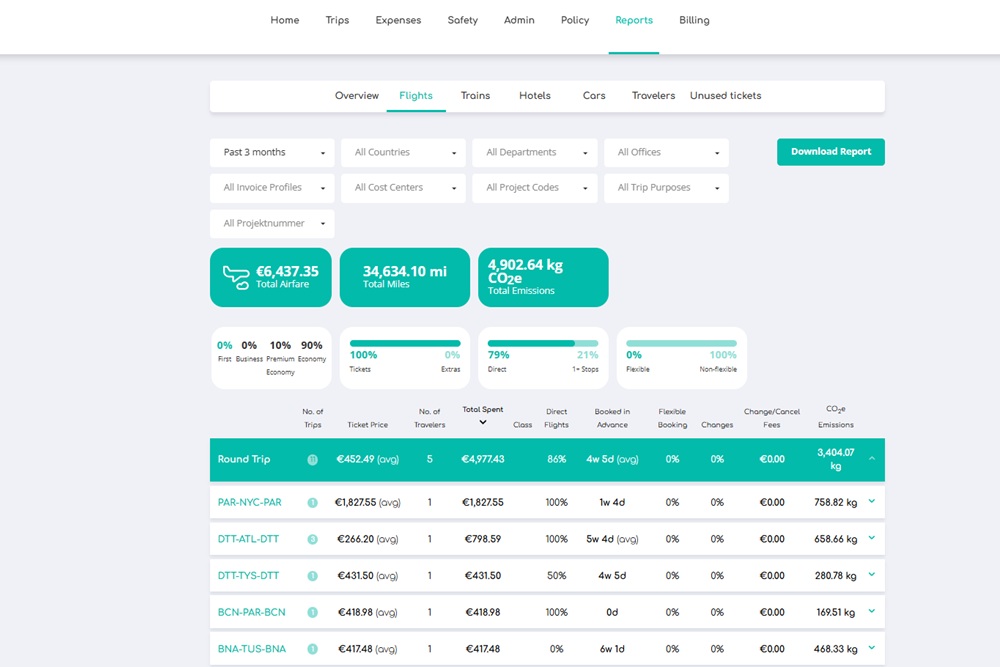
Secret #4: Track your company’s emissions
Find ways to track and visualize CO₂ emissions via dashboards like the ones available on GetGoing. This means reporting and insights can be seen on real-time dashboards, customizable filters and exportable reports for leadership and finance teams. The secret lies in connecting reporting to business decisions, tracking progress on sustainability goals alongside policy compliance and spend visibility.
How travel managers, HR teams and CEOs can utilize this information
Sustainability becomes far more actionable when data is captured, compared and reported consistently. For travel managers, this means using emissions data to guide smarter booking decisions and track progress over time; for HR teams, it means finding ways to support a work culture where responsible travel comes first; and for CEOs and leadership teams, it means having a clear, business-level view of how travel can contribute to your company’s environmental footprint.
Travel managers
You can use CO₂ emissions as a practical KPI alongside other KPIs from the travel program. By allowing for a side-by-side comparison, you can embed sustainable choices into the booking flow. With dashboards and exportable reporting, turn trip data into insights leadership can act on.

pro tip
It’s a good idea to help educate travelers on where rail should be preferred (like for short-haul routes where train is available) and communicate it as the “default choice.” You can do this by automating your travel policy.
HR teams can reinforce responsible culture without hurting the travel experience
CO₂ visibility supports employee awareness and participation in helping to reach sustainability goals and making impact understandable from the trip level. By being able to choose between flights and trains with side-by-side comparisons, you can encourage travelers to “do the right thing”.
Then you can communicate progress internally and celebrate improvements, recognizing those teams who produced the least amount of emissions on key routes. This will help incentivize travelers to make better decisions because recognition can go a long way. You may even consider setting up some sort of rewards program to give travelers even more incentive to be conscious when they book travel.
CEOs and leadership teams can turn sustainability into a business signal
CO₂ emissions are a clear, comparable metric that helps companies directly understand the impact of their travel program on climate change and by steering behavior in the right direction, you can encourage more sustainable choices, especially on routes where rail is viable. If you can measure CO₂ by trip and route, you can set realistic targets and monitor progress like any other business KPI.
Sustainability secrets recap
With smarter travel data, you can make better decisions that support the environment. Emissions visibility per trip and a flight vs. rail comparison at booking as well as having exportable reporting for businesses is key to making the right decisions.
Ready to make sustainability part of everyday travel decisions—not just a quarterly report?