

Business trips can contribute to carbon emissions; it’s a fact. Whether it’s a flight to meet a client, a train to a conference or a rental car to get you from A to B, all contribute to the environmental impact of business travel.
But knowing that business travel generates emissions is one thing. Knowing how much, where those emissions are coming from and how you can make more informed travel choices is another. This is where travel emissions tracking comes in handy.
Businesses can track travel emissions by capturing data from business trips, measuring the CO₂ associated with that travel and monitoring the results over time. And with a travel management platform like GetGoing, you can bring your travel data together, give travelers visibility into emissions while they book and use reporting to keep an eye on the bigger picture.
Let’s look at how it works.
What are business travel emissions?
Business travel emissions are the greenhouse gas emissions generated when your employees travel for work, such as:
- Flights
- Train journeys
- Rental cars
- Buses and other ground transportation
- Hotel stays
Getting visibility into these emissions is an important first step. But the real opportunity comes from using that information to make smarter travel decisions.
How do businesses track travel emissions?
Businesses need to know what travel is taking place before they can understand the emissions it generates.
That sounds simple enough. But imagine employees booking flights on one website, trains somewhere else, hotels directly with the property and rental cars through another provider. Add expense claims to the mix and you’re suddenly working with travel data from multiple sources.
A managed travel platform can make the process much easier. Below let’s explore how this can be possible.
1. Bring your business travel data together
Instead of piecing together individual bookings, invoices, receipts and expense reports, managing travel through one platform gives you better visibility into your company’s travel activity. The foundation becomes your travel data.
When business trips are managed in GetGoing, booking, travel and expense information can be brought together, making it easier to understand where and how your employees are traveling. This also creates a much more useful starting point for emissions tracking.
After all, knowing your company’s travel activity can help you also understand its overall environmental impact.
2. Capture the CO₂ impact of your trips
The next step to take is turning business travel activity into information about its environmental impact. For this there is the GHG Protocol, which takes three approaches to calculating business travel emissions:
- Fuel-based: calculate emissions based on fuel consumed and the appropriate emissions factor.
- Distance-based: determine the distance and mode of travel, then apply an appropriate emissions factor.
- Spend-based: calculate an estimate based on the amount spent on each mode of business transportation and relevant economic emissions factors.
From a travel-management perspective, the important thing is having reliable information about the trips taking place. However, the method your organization uses may depend on the data available and its wider carbon-accounting methodology.
With GetGoing, CO₂ emissions can be shown alongside flights during booking, helping bring environmental impact into the travel decision itself. Your existing GetGoing sustainability content also identifies trip-level CO₂ visibility as a way to turn emissions into a practical travel-management KPI.
3. Make emissions visible before travelers book
Tracking what you’ve already emitted is useful. But what if you could use emissions information before the trip takes place?
That’s where travel management technology can make a real difference.

pro tip
When travelers are comparing options, they typically consider factors such as:
- Price
- Departure time
- Journey duration
- Convenience
- Travel policy
CO₂ emissions can become another factor in that decision.
With GetGoing, travelers can see emissions information when searching for flights, giving them more information to consider alongside price, schedule and other booking factors.
Because the best time to think about the emissions from a business trip isn’t six months later when you’re looking at a report. It’s when you’re deciding how to get there.
4. Compare different ways of getting there
Flying isn’t always the only option.
For some journeys, particularly between well-connected European cities, taking the train can offer a practical alternative.
That’s why emissions tracking shouldn’t only answer:
How much CO₂ did we generate? It should also help you start asking: Could we travel differently?
When a rail option is available, GetGoing can surface rail alongside flight options, making it easier for travelers to compare how they could get to their destination.
That makes emissions data more actionable. Instead of finding out about your environmental impact after the fact, travelers can consider whether there’s another suitable option before they book.

5. Track emissions alongside your other travel KPIs
Travel managers and finance teams probably already keep an eye on things like travel spend, policy compliance and booking behavior.
So why not add CO₂ to the picture?
Tracking emissions alongside other travel metrics helps businesses understand environmental impact in the context of the wider travel program.
For example, you might want to understand:
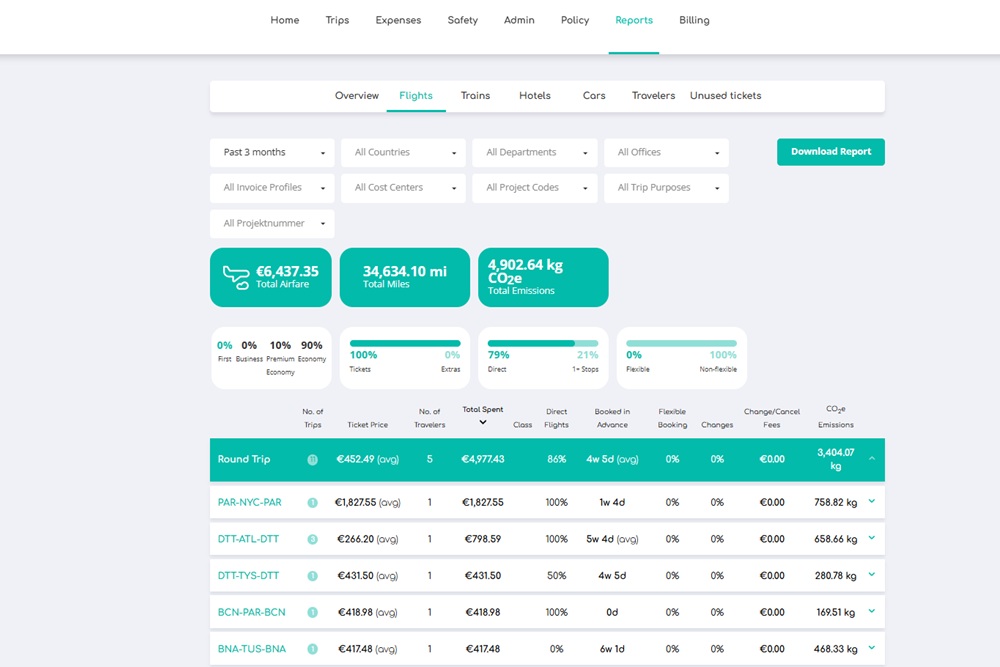
- Which journeys or routes contribute most to your travel footprint?
- How are your emissions changing over time?
- Where are alternatives to flying available?
- Are travel patterns changing?
- Are employees making different travel choices?
GetGoing’s reporting capabilities can help businesses visualize CO₂ emissions through dashboards and exportable reporting, alongside other travel-program information.
That makes CO₂ less of an abstract sustainability figure and more of a metric that can be monitored as part of everyday travel management.
6. Turn your emissions data into action
This is definitely one of the most important steps. Simply tracking emissions doesn’t reduce them.
The real value comes when you use your data to spot opportunities and make better decisions.
Imagine your travel data shows frequent short-haul flights on a particular European route where rail is a practical alternative.
You could encourage travelers to consider rail first for that journey.
Or perhaps your data shows that a lot of trips are being booked outside your preferred travel policy. Bringing those bookings into your managed travel program could give you better visibility while making it easier to manage costs, compliance and environmental impact together.
It’s a continuous process:
Measure → Compare → Act → Measure again.
Over time, this can help turn emissions data into something your business can actually use.
5 ways businesses can stay on top of travel emissions
1. Measure
Bring your travel data together and understand the CO₂ impact associated with your business trips.
2. Make it visible
Give employees access to emissions information when they’re making travel decisions, rather than only showing it retrospectively.
3. Compare
Where appropriate, give travelers different ways of reaching their destination so they can make a more informed choice.
4. Monitor
Track emissions over time and consider CO₂ alongside other travel KPIs such as spend and policy compliance.
5. Improve
Use what you learn to refine your travel program, policies and booking behavior. Then repeat the process. That’s how emissions tracking moves from being an annual reporting exercise to becoming part of how you manage travel every day.
How can GetGoing help you track business travel emissions?
Tracking business travel emissions shouldn’t mean digging through spreadsheets every time you want to know what’s happening.
By managing travel through GetGoing, businesses can bring booking, expense and reporting information together and get greater visibility over their travel activity.
CO₂ information can be shown alongside flight options at the point of booking, giving travelers another factor to consider when selecting how they travel. And when a comparable train journey is available, GetGoing can surface that alternative too.
From there, businesses can use dashboards and reporting to keep track of emissions alongside the other metrics that matter to their travel program.
It’s not simply about knowing your carbon footprint. It’s about having better information so your travelers, travel managers and business can make more informed choices.
From tracking travel emissions to making smarter choices
Knowing the size of your business travel footprint is useful. Knowing what to do about it is even better.
Bringing travel data together, making CO₂ more visible and giving travelers alternatives at the point of booking can make sustainability a more practical part of business travel. And instead of thinking about emissions only when it’s time to prepare a report, businesses can keep them in mind every time someone travels.
With GetGoing, you can bring booking, expenses and travel reporting together in one platform, helping you keep a closer eye on how your business travels and giving employees the information they need to make more informed choices.
Ready for better visibility over your business travel? See how GetGoing can help you manage travel, expenses and emissions in one place.
FAQs about tracking business travel emissions
How do companies track business travel emissions?
Companies can track business travel emissions by collecting information about employee trips and using that data to calculate the associated CO₂e. Depending on the methodology used, businesses can calculate emissions based on factors such as fuel consumption, distance traveled or travel spend.
Using a travel management platform can make it easier to centralize travel activity and monitor emissions alongside other travel data.
What are Scope 3 business travel emissions?
Under the GHG Protocol, travel by employees for business purposes using transportation owned or operated by third parties falls under Scope 3, Category 6: Business Travel. This can include air, rail, bus and car travel. Employee commuting is different. That’s classified under Scope 3, Category 7.
What data do businesses need to track travel emissions?
Depending on the calculation methodology, businesses may use information such as travel mode, journey distance, fuel use and spend. Having centralized booking data can make it easier to understand your overall travel activity and feed relevant information into your sustainability processes.
Can a travel management platform help track CO₂ emissions?
Yes. A travel platform can help by keeping travel activity in one place and making emissions data easier to see and monitor. GetGoing can display CO₂ associated with flights during the booking process and provide businesses with emissions information through reporting, helping make carbon visibility part of everyday travel management.
How can businesses reduce travel emissions?
Start by understanding where your business travel emissions are coming from. Then identify opportunities to make changes, such as considering rail instead of air where practical, making emissions visible during booking, consolidating travel data and adapting travel policies based on what your data tells you.
How much lower are rail emissions than flying?
Much lower on most routes. In a UK government worked example, a trip from London to Glasgow produces about 28 kg CO2e by train and 108 kg CO2e by plane, before the extra effect of emissions at altitude are added. Switching short flights to rail is usually the quickest way to cut travel emissions.
Does CSRD apply to small and medium-sized businesses?
Not directly. Since the EU Omnibus I Directive entered into force on 18 March 2026, CSRD reporting only applies to EU companies with more than 1,000 employees and more than €450m net turnover. SMEs can still be asked for emissions data by larger customers that report.