

A rail travel policy is not just a sustainability wish but a practical policy upgrade. When it comes to train vs. plane for business trips, many corporate travelers would happily travel by train rather than by plane. Avoiding long security lines, hefty wait times at the airport and traveling far distances is a great time and stress saver for business trips.
However, many travelers report no clear rail policy or lack of awareness of the basics they need to book rail. This is why it’s important to know exactly how to add rail to your corporate travel policy. By the end, you’ll have a plug‑and‑play set of rules, as well as a sample policy section you can drop into your travel policy.
What is a rail travel policy?
A rail travel policy is the part of your corporate travel policy that establishes when rail should be used, how to book, which class is allowed, and how expenses are paid/claimed.
A good rail travel policy should include:
Set your “rail vs air” rule
Rail vs. air is a simple decision hierarchy. Many organizations position rail as a short‑distance alternative, often because it’s cost‑effective and keeps travel time limited, but it’s important to have clear what the threshold is for choosing rail over air.
Pick a threshold type
- Journey time threshold (e.g., “rail preferred under X hours”)
- Cost/time comparison rule (e.g., when time and cost are similar, choose rail)
- Route-based rule (some cities, especially in Europe are well-connected by train, e.g., London to Paris, Paris to Brussels, Madrid to Barcelona). When those city pairs are in the travel plans, encourage train use.
Define when air is allowed
When all things are equal, rail is always encouraged as it is the more sustainable and environmentally-friendly option. That being said, it’s important to integrate some exceptions into your policy. Some examples of exceptions:
- No viable rail connection
- Accessibility needs
- Same-day multi-stop itinerary constraints

Define rail booking rules
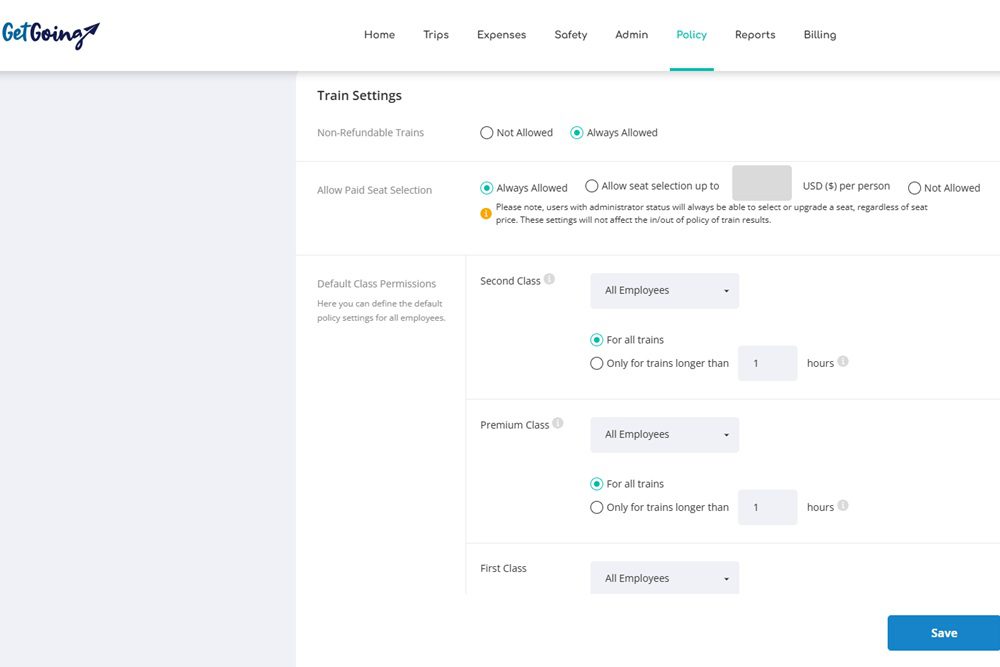
Within your travel policy, define when rail must be booked, what class of service is allowed and the policy regarding seat reservations and add-ons.
Where rail must be booked
- In your travel policy, clearly state which is the preferred travel management platform. E.g., “Book through our designated platform/agency, GetGoing”
Allowed class of service
Use a rule that reflects real policy patterns:
- Class of service may be depending on the length of the trip or the level of executive. For example: EMEA trips ≤ 6 hours booked in Coach, and business/first- class for longer journeys or for business executives.
- Many define rail class of service, but it’s less standardized than air policies.
- Specify when express trains can be used for certain routes, which can be more expensive
Seat reservations & add-ons
Paid seat reservations may not be necessary on a train, unless it is to book a type of seat that is more adapted to working from the train. When regular seats don’t have a table or desk to work from, then it might be worth adding this option into the policy. Add-ons like pre-ordered hot meals, refundable or changeable tickets, or additional luggage allowance can be exceptions written into your travel policy.
How to manage reimbursement + out-of-policy bookings
Common challenges with out-of-policy bookings or trouble with reimbursement all stem from having a lack of a clear rail policy. This is why it’s important to spell out in the travel policy how and when travelers will be reimbursed and that they know all the rules for booking.
Payment & reimbursement rules
Be sure to spell out what is the best way to pay, whether that be a corporate card vs personal card, required receipt/confirmation, and timelines.For agent-driven booking contexts, internal guidance lists the info needed (card details etc.)
Out-of-policy bookings
- Be sure to include a section, “what happens if…” (approval, reason, how to ask for an exception)
- To avoid out-of-policy bookings make sure your rail policy is carefully spelled out and automated within your travel management platform
Pro Tip: The easiest way to manage payment and reimbursement is by working with an all-in-one travel management platform where you can automate your travel policy and boost compliance at the same time.
Communicate guidelines
Communicate policy changes across multiple channels (intranet, direct emails) and targeted messaging directly in the online booking tool.
What’s needed to communicate deadlines
- Update policy doc + booking tool rules
- Add a 1‑page “rail vs air” decision chart
- Announce + reinforce
- Measure compliance
Copy/paste: sample rail section for your travel policy
Train travel
If you need to take an international train, book through our designated [travel agency or travel platform]. All employees should travel in 2nd class (or whatever the international equivalent is), except for management who is permitted to travel in first class. Seat reservations for which a fee applies are not allowed.
Make sure to include:
- When rail is required/preferred (threshold)
- Booking channel
- Class of service
- Seat reservations/add-ons
- Payment/reimbursement
- Exceptions/approvals
Don’t have a travel & expense policy yet?
Get actionable insights about how to set up your travel and expense policy + free template included.
Why a rail travel policy is important
A rail travel policy is important because beyond helping companies control costs, it helps reduce their environmental impact and improve the overall travel experience for employees. By encouraging rail over short-haul flights, businesses can lower carbon emissions and support sustainability goals. A clear rail travel policy ensures consistent decision-making that aligns with travel behavior and company priorities. It works best when it’s simple, easily bookable, and well-communicated. This is why it’s so important to incorporate a rail-first policy into your corporate travel and expense policy.
A rail policy works when it’s simple, bookable, and well-communicated. This is why it’s so important to incorporate a rail-first policy into your corporate travel and expense policy.
FAQ
What is a rail travel policy?
A rail travel policy is a part of a corporate travel policy designed to help employees take advantage of train travel on their corporate trips. It outlines the approval process, what’s in policy and the procedure to book a business trip by train.
When should employees take the train instead of flying in Europe?
Employees should take a train instead of flying in Europe for short distances or for popular rail routes within Europe between capital cities.
What class can employees book on trains?
All employees should travel in 2nd class (or whatever the international equivalent is), except for management who are permitted to travel in first class.
How do we avoid out-of-pocket rail reimbursement issues?
It’s ideal to use a corporate travel management platform that allows you to manage corporate payments or to use a company credit card.